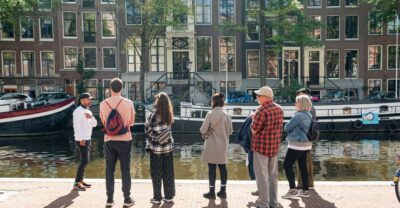
Amsterdam turns history into street stories. In two hours you follow the Jewish Quarter through the Nazi occupation, with a small-group cap of 15 and a finish by Anne Frank House.
I like that the walk connects everyday places to big events, so you’re not just staring at plaques. I also like that the guide coverage spans Jewish life before, during, and after 1940–1945, including deportations and resistance. The one thing to consider is that the topic is emotionally heavy, so go in with some room in your head for hard facts and tough moments.
In This Review
- Key highlights you should care about
- Jewish Quarter in Amsterdam: why this walk makes sense
- Meeting at Amstel 51C: timing, pace, and what you’re signing up for
- Jewish Golden Age to an active synagogue: where the story begins
- Nazi occupation, deportations, and the monuments you can’t ignore
- Resistance and courage: learning how survival was discussed on the streets
- Deportation camps: how the tour handles the hard logistics of history
- Plantage District and everyday Amsterdam: history in the geography
- Spinoza monument: using a philosopher to understand the larger story
- Dam Square and the Royal Palace: connecting two Amsterdams
- Ending near Anne Frank House: what to do next
- Guides make the difference: why Aaron, James, and Andrea get name-checked
- Price and value: is $29.52 really a good deal?
- Who should book this walking tour (and who should think twice)
- Should you book the Amsterdam Jewish Quarter Heritage Walking Tour?
- FAQ
- How long is the Amsterdam Jewish Quarter Heritage Walking Tour?
- How much does the tour cost?
- What language is the tour offered in?
- How big is the group?
- Where does the tour start?
- Where does the tour end?
- Is hotel pickup included?
- Is the Anne Frank House entrance ticket included?
- Are service animals allowed?
- What if the weather is bad?
- Is there free cancellation?
Key highlights you should care about
- 15-person maximum: a real conversation pace, not a cattle-walk
- Nazi occupation focus (1940–1945): clear timeline, not vague storytelling
- Ends right by the Anne Frank House area: easy to continue on your own
- Plantage District + Spinoza monument: Jewish Amsterdam beyond WWII
- Dam Square and Royal Palace nearby: you’ll tie this history back into the modern city
- English guided tour with mobile ticket: simple setup for most visitors
Jewish Quarter in Amsterdam: why this walk makes sense
If you want to understand Amsterdam beyond canals and bicycles, this is a strong place to start. The Jewish Quarter is where you can still read the past in buildings, memorials, and street corners. And because the route is compact, you don’t waste half your day just getting between stops.
What I appreciate is how the story keeps its footing in real locations. You’re not stuck with abstract history. Instead, you’re shown how the Nazi occupation reshaped Jewish life, and how the city remembers what happened afterward.
This is also one of those tours where guides matter. Based on the tour guides you might get, names like Aaron, James, and Andrea come up again and again for a reason: they focus on human details and careful pacing, not just dates and facts. For many people, that’s what turns an informative walk into something that actually stays with you.
You can also read our reviews of more walking tours in Amsterdam



Meeting at Amstel 51C: timing, pace, and what you’re signing up for
The tour starts at Amstel 51C, 1018 EJ Amsterdam. It’s also near public transportation, which helps a lot in a city where your feet will already be doing plenty of work. The duration is about 2 hours, so it’s long enough to cover multiple major sites, but short enough that you can still enjoy the rest of your day.
Group size is small (up to 15), which usually means the guide can answer questions without steamrolling the room. It’s also listed as a private tour, but the practical experience is still that of an intimate group walk. Hotel pickup and drop-off exist for selected hotels, which can make the day easier if you’re staying nearby.
One practical tip: wear shoes you trust. This route moves through older neighborhood streets, and you’ll be on your feet while the guide explains each stop’s significance. Plan to slow down and listen, not to speed-run photos.
Jewish Golden Age to an active synagogue: where the story begins
The first major stop sets the tone by taking you back to the Jewish community of Amsterdam and the Sephardic chapter of it. During the Dutch Golden Age, the Sephardic community was among the largest and richest Jewish communities in Europe. That mattered, because it shows up in architecture—especially in the kind of religious spaces a community could build and maintain.
You’ll learn about a synagogue tied to that era that is still an active place of worship today. It’s also described as a popular tourist attraction, which is useful context: you’re going to see a functioning site, not just a historical shell.
The value here is that it corrects a common mistake: assuming the Jewish story in Amsterdam starts with WWII. It doesn’t. You get the earlier community, its scale, and its presence in the city before the occupation years change everything.
If you’re the type who likes to understand how a place looked before tragedy, this opening stop does that work fast.
Nazi occupation, deportations, and the monuments you can’t ignore
After setting the stage, the tour moves into the years of the Nazi occupation of the Netherlands (1940–1945). This is where the walk turns serious. You’ll see a monument connected to Jewish deportation, and you’ll also hear about the role of resistance within the Jewish community.
One of the strongest points—highlighted in guide-led experiences—is the way the tour connects names to numbers. A common standout is the Holocaust memorial wall listing the names of 102,000 Jews from the area who were killed. That kind of detail doesn’t just add emotion; it helps your brain understand that mass murder was made of individuals, not a statistic.
Guides like Aaron and James are specifically praised for discussing these locations with sensitivity and clear human context. The pacing seems to matter here: many people call it thought-provoking rather than just heavy.
A consideration: because this part of the tour is factual and emotional, it may feel like you’re processing more than you expected from a “walking tour.” If you’re visiting with a small kid, or if you’re easily overwhelmed by Holocaust content, you might want to mentally prepare (and consider shorter sightseeing blocks afterward).
Resistance and courage: learning how survival was discussed on the streets
Resistance is often taught as a big, heroic movie montage. Here, you get something more grounded: the idea of resistance as part of Jewish community life under pressure. The route includes a stop focused on Jewish resistance, so the guide can explain how people tried to protect each other, resist deportation efforts, or respond to the machinery of occupation.
This matters because it balances the emotional weight. You’re still learning what was done to Jewish people, but you’re also shown that there wasn’t just passive tragedy. People acted with the tools they had—knowledge, networks, and, in some cases, direct risk.
In a good tour, that balance keeps the story from turning into a one-note tragedy. From the guide reputations around Aaron, James, and Andrea, the tone you’ll likely get is careful and respectful, with space for reactions and questions.
You can also read our reviews of more historical tours in Amsterdam






Deportation camps: how the tour handles the hard logistics of history
The itinerary includes a stop where you learn about deportation camps. That phrase can sound clinical, but on this kind of walk it usually means turning the abstract into a clear, chronological explanation tied to what happened to people from Amsterdam.
This is where a well-led tour helps most. When guides handle it well, you don’t just get a grim list. You get a sense of the system—how deportations were carried out and why the Nazi plan spread beyond borders into neighborhoods and families.
I’d treat this section like a checkpoint for your attention. If you find your mind drifting, bring it back. The more you track the timeline and connections between stops, the more the story clicks into place.
Plantage District and everyday Amsterdam: history in the geography
Then comes the Plantage area, described as a “beautiful area and history” moment within the tour. This section is important because Amsterdam’s Jewish story isn’t only memorial plaques and trauma narratives. You’re also shown how community presence shaped parts of the city.
The Plantage stops help you see the neighborhood structure—how the city’s layout and daily movement could matter for how people lived and, tragically, how they were targeted. It’s also a reminder that after WWII, Jewish life and memory remained part of Amsterdam’s identity.
If you tend to remember places by visuals, this portion is useful. You’re walking through areas that still look like part of the city you’re enjoying today, and the guide layers historical meaning on top.
Spinoza monument: using a philosopher to understand the larger story
The tour includes a stop at the Spinoza monument. That’s a smart choice for a heritage walk because it shifts you from the WWII years back into intellectual and cultural identity.
Spinoza is tied to Amsterdam’s long Jewish presence and the broader story of Jewish thinkers in Europe. Even if you don’t know much about him beforehand, the guide’s explanation should give you a lens for understanding that community identity wasn’t only defined by religion or politics. It also included language, ideas, and scholarship.
This stop can feel like a breath of clarity after the heavier sections. Not because the subject becomes light, but because the theme widens again: people created culture even while facing danger and restriction.
Dam Square and the Royal Palace: connecting two Amsterdams
Next, the walk heads to Dam Square and the nearby Royal Palace monument area. This is a good trick of route design. You start in Jewish heritage sites, then you bring the story back to one of Amsterdam’s central public spaces.
By the time you reach Dam Square, you’re not just hearing about the Jewish Quarter in isolation. You’re learning how these histories connect to the city as a whole, including the national and civic stage where power and public memory meet.
This part also helps with orientation. Dam Square is a major landmark. If you’ve just arrived in Amsterdam or you’re still getting your bearings, ending up around Dam Square can help you plan the next leg of your day—museums, canals, or just a long wander.
Ending near Anne Frank House: what to do next
The tour finishes right by the Anne Frank House area. That’s a major reason the booking rate is strong—people want their walk to end at a site they’ll likely want to visit or re-visit.
One key detail: the tour does not include an entrance ticket to the Anne Frank House. So if you want to go inside, plan to buy that separately. This can be a plus, too. It means you can choose timing based on your schedule and ticket availability.
It’s also worth noting the tour is described as ending back at the meeting point in the booking info. In practice, you can expect to finish near Anne Frank House while the overall activity is tied back to the start area for closure. Either way, the key is that you’ll be in the right zone to continue on your own without backtracking your whole day.
Guides make the difference: why Aaron, James, and Andrea get name-checked
In the real world, history tours can be uneven. The standout factor in this experience is how often guides like Aaron, James, and Andrea are praised for clarity and sensitivity. People specifically mention that these guides explain with thoughtfulness, answer questions, and keep the emotional tone appropriate for memorial sites.
If you have questions—about collaborators, deportation process, resistance, or why specific monuments are placed where they are—this tour’s format seems built for that. A maximum of 15 people also helps. Your guide can actually notice if someone needs a slower explanation.
So if you’re choosing between a general “Jewish Amsterdam” walk and a WWII-focused heritage route, pay attention to the guide quality. Here, the guide experience is part of the value.
Price and value: is $29.52 really a good deal?
At $29.52 per person, this is priced like a compact walking tour, not like an all-day museum program. And that’s exactly how it works: you get a guided route that hits major themes in about 2 hours.
You’re also getting several value boosters:
- Local guide expertise built around real stops
- Small-group format (max 15)
- Route design that covers multiple key points in one go, so you don’t have to map it yourself
The only extra cost to think about is the Anne Frank House entrance ticket, since it’s not included. But if you were already planning to visit, this tour acts like strong context before you go in. And if you’re not sure you want to enter, you still end in the right place to decide on the spot.
Also, it’s been commonly booked about 44 days in advance, which is a hint that popular time slots can fill. Booking ahead is a smart move if you want a specific day.
Who should book this walking tour (and who should think twice)
This tour is a great fit if you want:
- A focused Amsterdam Jewish heritage overview tied to the Nazi occupation years
- A route that connects memorial meaning to physical locations
- A guide-led explanation with time for questions in a small group
It’s also a solid choice if you like your sightseeing with a “why” behind it. The best parts aren’t only what you see, but why the guide connects each stop to the wider story.
Think twice if:
- You’re looking for something light and casual. This includes deportation and WWII content.
- You need purely upbeat content for a multi-day trip. Consider pairing it with a calmer activity afterward.
Should you book the Amsterdam Jewish Quarter Heritage Walking Tour?
Yes, I’d book it if you’re in Amsterdam long enough to want one history-focused walk that actually sticks to the street. The small-group size, the clear WWII time frame (1940–1945), and the way the route threads together Sephardic life, deportation monuments, resistance, Plantage, and Spinoza give you a full story arc without turning it into a marathon.
Two practical reasons to pick it over DIY: first, the guide helps you read what you’re seeing. Second, it ends near Anne Frank House, so you can smoothly continue your day without needing a separate plan for context.
If the topic of deportations and Holocaust history feels too intense for your current trip mood, save it for another day—or choose a different style of tour. But if you can handle the seriousness, this is a high-value walk that turns Amsterdam’s Jewish Quarter into something you understand, not just something you pass by.
FAQ
How long is the Amsterdam Jewish Quarter Heritage Walking Tour?
The tour lasts about 2 hours (approximately).
How much does the tour cost?
It costs $29.52 per person.
What language is the tour offered in?
The tour is offered in English.
How big is the group?
The tour has a maximum of 15 travelers.
Where does the tour start?
It starts at Amstel 51C, 1018 EJ Amsterdam, Netherlands.
Where does the tour end?
The tour ends right outside the Anne Frank House museum area, and the activity is also described as ending back at the meeting point.
Is hotel pickup included?
Hotel pickup and drop-off are included for selected hotels only.
Is the Anne Frank House entrance ticket included?
No, the Anne Frank House entrance ticket is not included.
Are service animals allowed?
Yes, service animals are allowed.
What if the weather is bad?
This experience requires good weather, and if it’s canceled due to poor weather, you’ll be offered a different date or a full refund.
Is there free cancellation?
Yes. Free cancellation is available up to 24 hours in advance for a full refund.