REVIEW · AMSTERDAM
2 Hours Private Amsterdam Rickshaw Tour
Book on Viator →Operated by BlackfoXXX Amsterdam explorer · Bookable on Viator
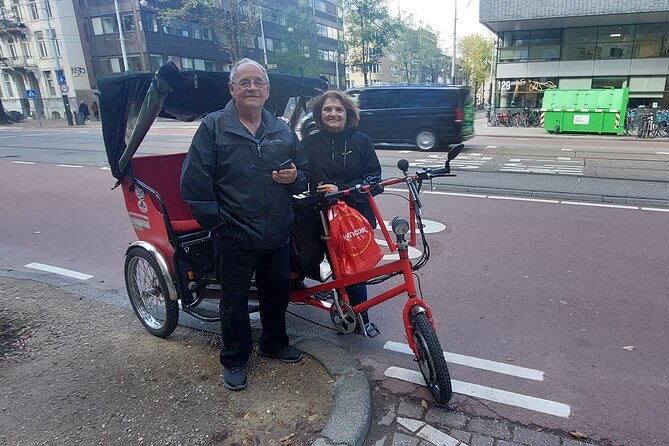
Riding a rickshaw is the quickest intro to Amsterdam. This private 2-hour ride is built for seeing a lot without the stress of traffic or finding the fastest walking routes, and it has that calm, sit-and-enjoy feeling. I especially like how the rickshaw can go places buses and boats can’t reach, and I also like the guide’s habit of stopping so you can look closely and grab photos. One consideration: the tour needs good weather, and you’ll want layers if it’s chilly or windy.
You get pickup offered, a mobile ticket, and even Wi‑Fi on board, which is handy for maps and messaging while you’re out getting oriented. It’s also limited to your group only, so it works well if you want control over pace—slow down here, spend a minute longer there.
The big idea is simple: you’re buying time and comfort. In two hours, you’ll cover major squares and neighborhoods, plus the canal-side vibe around Museumplein and the Museum Quarter, without wearing your feet out.
In This Review
- Key Things That Make This Tour Worth It
- Entering Amsterdam’s Main-Sight Loop (Dam Square to Red Light District)
- Seeing the Red Light District With a Level Head
- Nieuwmarkt: Old Commerce, Market Energy, and Terrace Time
- Rembrandtplein After Its Dairy-Market Days
- Magere Brug: The Skinny Bridge Story That Actually Makes Sense
- Museumplein, Concertgebouw, and the Art-Filled “Room” of the City
- Anne Frank House Area: A Serious Stop in a Moving Day
- Vondelpark: When Amsterdam Stops Moving for a While
- De Gooyer Windmill: A Quick Look at What Survived
- De 9 Straatjes: Where the Canals Become a Boutique Shortcut
- The Guide, the Pace, and Why This Feels Relaxed
- Pickup, Getting There, and How Easy It Really Is
- Price and Value: When Private Costs Make Sense
- Should You Book This Amsterdam Rickshaw Tour?
- FAQ
- How long is the 2-hour private Amsterdam rickshaw tour?
- How much does the private tour cost?
- Is the tour private or shared?
- What group size and weight limits apply?
- Do you offer pickup in Amsterdam?
- What language is the tour offered in?
- What’s included during the ride?
- What stops are included on the route?
- What’s the cancellation and weather policy?
Key Things That Make This Tour Worth It
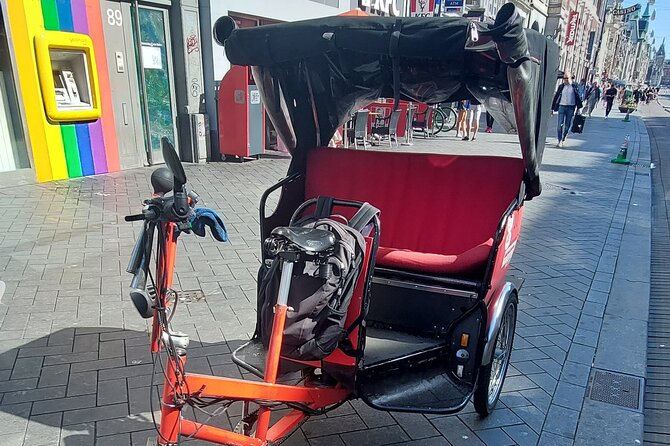
- Private rickshaw, up to 2 adults: You stay in a small group, so your guide can actually tailor photo stops and pacing.
- Rickshaw access for tricky areas: It can roll through areas where bigger vehicles can’t, which makes the route feel more “street-level” than bus tours.
- Hotel pickup in the city center: Fewer logistical headaches, especially if you’re staying in the classic canal-belt area.
- Frequent photo and stop opportunities: The guide pauses so you can see details and take pictures without rushing.
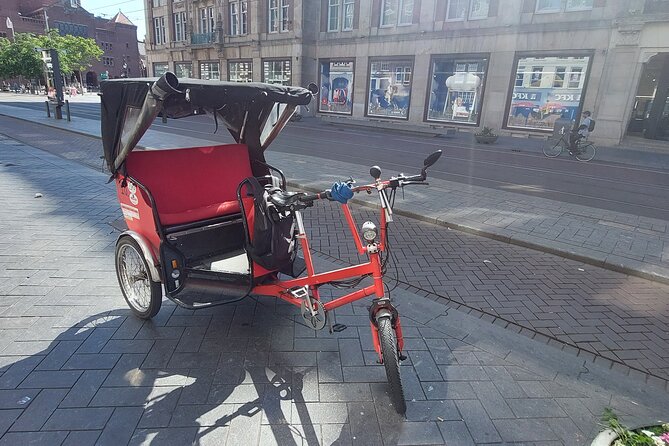
- Comfort for rain and wind: The ride setup includes protection, and the experience has a reputation for offering blankets when the weather turns cool.
Entering Amsterdam’s Main-Sight Loop (Dam Square to Red Light District)
Amsterdam has a way of stacking time on top of itself. This tour starts right where the city’s story turns from legend into layout: Dam Square.
Dam Square began as a 13th-century dam built around the Amstel to protect the city from flooding tied to the Zuiderzee. It’s wild to think a structure made for survival is now one of the loudest, most animated squares in town. In the 1960s, it was known for hippies; today it’s all about tourist energy, street entertainment, and yes, plenty of pigeons. Depending on when you go, there may be spring carnival vibes or a colorful ferris wheel, and in summer you can catch mimers and street performers.
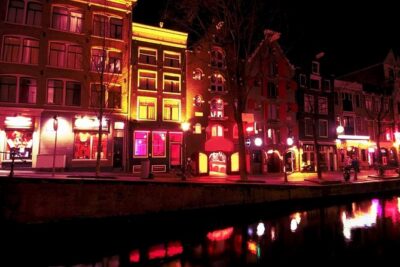
From there, the ride rolls into the area most people have an opinion about before they ever see it for themselves: the Red Light District. This is where the tour’s “you can’t get the full picture from postcards” value shows up.
You can also read our reviews of more private tours in Amsterdam

Seeing the Red Light District With a Level Head
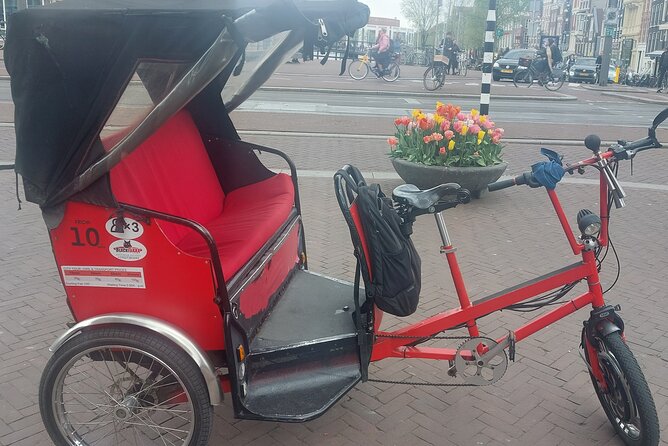
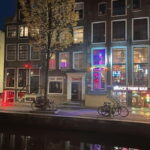
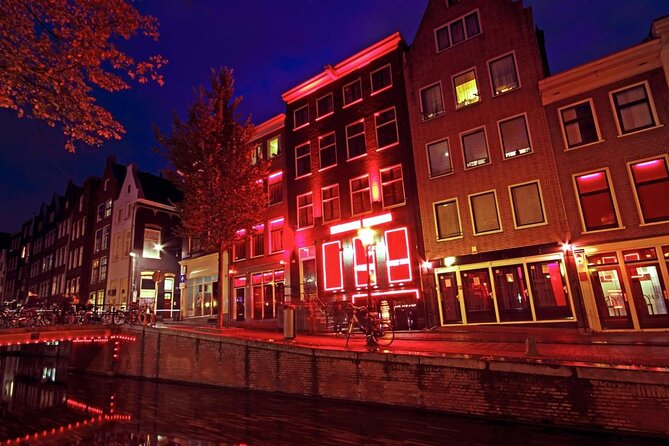
The Red Light District has plenty of what you’ve heard—brothels, sex shops, and also museums. But the atmosphere you experience here is described as friendly and not as dangerous as it used to be. That’s important context because Amsterdam is a city where the streets are public and the rules of behavior matter more than sensational headlines.
What I like about seeing it by rickshaw is that you’re not trapped in a crowded walking flow where everyone is trying to photograph the same corner. You can look, learn what’s there, and keep moving at a human pace. Just keep it respectful. This is still an adult neighborhood, and locals live and work nearby.
Nieuwmarkt: Old Commerce, Market Energy, and Terrace Time
Next you move toward the old city center’s Nieuwmarkt, just east of the Red Light District. This square grew into a hub of commerce and social life as far back as the 17th century, when the canals around it were filled in. That detail explains the feel of the place: it’s more square-and-street than canal-and-boat.
Nieuwmarkt still hosts a daily market, and on Saturdays there’s an organic market. Even if you’re not shopping, the real draw is how many cafés and restaurants surround the square, with coffeeshops in the mix too. If you get a sunny moment, this is a great spot for the “slow down and watch people” style of Amsterdam.
There’s also a practical note: the Nieuwmarkt metro stop is on the square, and construction drew protest at the time. Today it’s one of the city’s central metro points, which can partly explain why the area stays lively and easy to reach.
Rembrandtplein After Its Dairy-Market Days
Then the ride heads to Rembrandtplein, one of Amsterdam’s busiest squares, especially when it comes to nightlife and clubbing. Before it became what you see today, it was originally a butter and dairy market. That kind of shift is very Amsterdam: a place built around daily commerce can evolve into entertainment without losing its core “people gather here” function.
If you’re thinking, I’m here for culture, not nightlife—good. You can still enjoy Rembrandtplein as an urban stage set. It’s a useful stop because it shows how Amsterdam layers everyday city life with late-night energy, all in the same few blocks.
Magere Brug: The Skinny Bridge Story That Actually Makes Sense
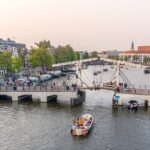
One of the most photo-friendly moments is the skinny wooden bridge across the Amstel, opposite the Carré theatre: Magere Brug. This is an Old Dutch design double-swipe (balanced) bridge, which is a fancy way of saying it’s built to move with impressive symmetry.
Tradition has a romantic story behind the name: it’s tied to the sisters Mager, said to have lived on opposite sides and to have had the bridge built so they could visit each other. But there’s another explanation that feels just as plausible: the bridge is called mager because it’s narrow—hard for two pedestrians to pass along each other.
On the rickshaw, you get the perfect combo: a quick look with context from your guide, then a chance to pause so you can frame the bridge and the river properly. This stop is short, but it hits the “Amsterdam looks like a storybook” button.
You can also read our reviews of more tours and experiences in Amsterdam


Museumplein, Concertgebouw, and the Art-Filled “Room” of the City
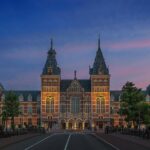
Next comes Museumplein, a public space in the Museumkwartier area. It’s less a single building and more a whole outdoor “front room” for culture.
Museumplein is where you find three major museums: the Rijksmuseum, Van Gogh Museum, and Stedelijk Museum, plus the Concertgebouw. Even if you don’t go inside any museum during your tour, seeing the spacing and layout helps you understand how the area works. It also makes it easier later to plan where you want to spend real time on your own.
This part of town is also a good indicator of Amsterdam’s practical planning style. It’s designed so big destinations connect through public space, not only through canals and hidden alleys.
Anne Frank House Area: A Serious Stop in a Moving Day
The tour passes the Anne Frank House area—Anne Frank’s writer’s house and biographical museum dedicated to her wartime diary. The building sits on the Prinsengracht canal, close to the Westerkerk, in central Amsterdam.
This isn’t a “fun photo stop” type of moment, and that’s okay. The value here is context: you get the location in your head, so later, if you decide to visit, you’ll understand where you are and why it matters. If you’re doing other attractions the same day, I suggest keeping your mind switched into a quieter gear here.
Also, by viewing it from the route instead of trying to force it into a tight walk, you reduce the risk of rushing through something meaningful.
Vondelpark: When Amsterdam Stops Moving for a While
After the more intense city-center sights, the ride heads into Vondelpark, Amsterdam’s largest city park and the country’s most famous one.
This is where you see how locals recharge. On sunny days, Amsterdammers and tourists relax in grass, walk dogs, jog, roller-skate, listen to music, and people-watch. There are free concerts too, either at the open-air theatre or, in summer, at the bandstand.
The park also has named attractions you might spot from the ride or in your own future exploring: a statue of the poet Vondel, a cast iron music dome, the Groot Melkhuis with a playground for children, and the historical Pavilion with a restaurant called Vertigo that opens in summer and offers a popular terrace.
If you want one quick “reset” stop during a short stay, Vondelpark is it.
De Gooyer Windmill: A Quick Look at What Survived
Then the tour includes De Gooyer Windmill. This is an 18th-century grain mill and the sole survivor of five windmills that once stood in that area. De Gooyer was moved to its current spot in 1814, fully renovated in 1925, and it’s now a private home.
Alongside the windmill, the public baths were converted into Brouwerij ’t IJ in 1985. It’s a small stop—about five minutes—and an admission ticket isn’t included for the windmill itself. Still, it’s a neat snapshot of Amsterdam’s industrial past and how older structures get repurposed rather than erased.
De 9 Straatjes: Where the Canals Become a Boutique Shortcut
To wrap up, the ride heads toward De 9 Straatjes—the Nine Streets shopping area. It sits between the Singel, Herengracht, Keizersgracht, and Prinsengracht, and it’s known for one-of-a-kind boutiques, stylish cafés, and galleries in those narrow canal streets.
This is the kind of area where Amsterdam becomes slower, moodier, and more “wandering-friendly.” Even if you don’t shop, the streets are a good way to end your tour because they feel different from big museum plazas and landmark squares.
The Guide, the Pace, and Why This Feels Relaxed
The best rickshaw tours aren’t just about places—they’re about pace. This one tends to win people over with how the guide handles motion.
Guides you might get (based on the name you’ll hear on the day) include Lampros, with other similar variants showing up in past experiences. What matters is the style: they’re friendly and practical, and they’re not trying to talk nonstop while pedaling. One detail I really appreciate is when the guide stops and gets off to explain things, so you can actually hear the story and still take a photo.
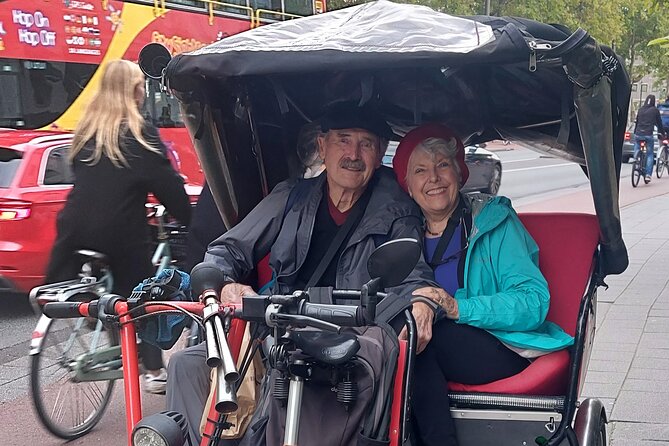
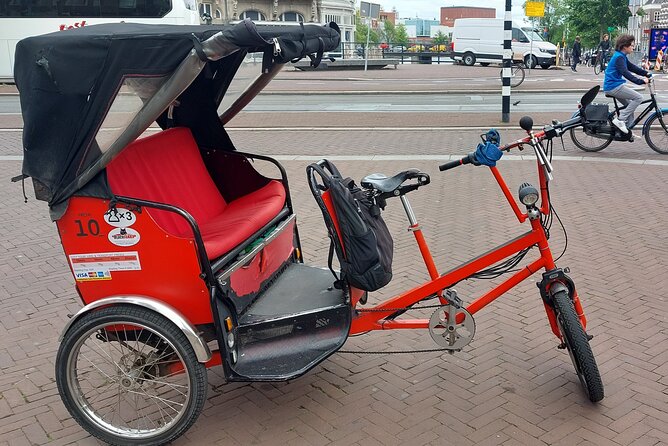
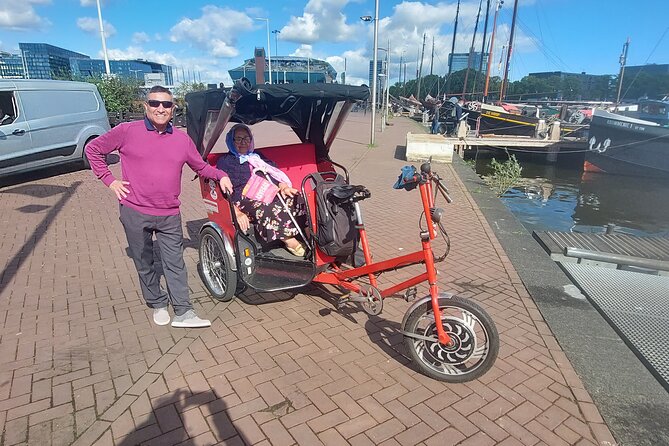
The ride is also set up for comfort. A clean rickshaw with protection from rain and wind is a big deal in Amsterdam weather. In cooler conditions, blankets have been part of the experience. So if you’re the type who gets cold easily, pack accordingly even if the forecast looks mild.
Pickup, Getting There, and How Easy It Really Is
Pickup is offered, and if you’re staying in the city center, it’s often easiest to pick you up from your hotel. That cuts down on uncertainty, especially if you’re navigating canal-side streets that can be confusing with luggage or tight schedules.
If you’re arriving by cruise, pickup can be arranged too. Most sea cruiseships dock at PTA, while most river cruiseships dock at either De Ruyterkade Oost or De Ruyterkade west. If you’re not sure where to meet, you can suggest a place—or the guide can suggest a couple locations if needed.
A practical mindset for your day: plan to be ready a few minutes early. The tour runs smoothly when you treat pickup like a small appointment, not a casual meetup.
Price and Value: When Private Costs Make Sense
At $234.30 per group (up to 2 people), this isn’t a bargain-basement price. But it can be good value because you’re paying for a private, custom-feeling tour that includes:
- a 2-hour guided route across major districts,
- pickup offered,
- a mobile ticket,
- Wi‑Fi on board,
- and the comfort factor of not walking or cycling.
For two people, the math usually works out like a “split the cost, buy the convenience” decision. If you’re traveling solo, the price can feel steep versus group tours, but if you strongly prefer comfort and a fast overview, it can still be worth it.
Should You Book This Amsterdam Rickshaw Tour?
Book it if you’re:
- visiting Amsterdam for a short time and want an efficient overview,
- not feeling up for long walks across multiple neighborhoods,
- traveling with a partner and want private pacing,
- or you want a way to see parts of the city that buses and boats can’t reach.
Skip it (or pair it differently) if:
- you’re expecting a museum-heavy day with lots of interior time, or
- you know you’ll be miserable in cool, windy weather without flexibility.
FAQ
How long is the 2-hour private Amsterdam rickshaw tour?
It runs for about 2 hours.
How much does the private tour cost?
It’s $234.30 per group (up to 2).
Is the tour private or shared?
It’s private. Only your group participates.
What group size and weight limits apply?
The rickshaw allows up to 2 adults with a total weight up to 500 pounds (230 kilograms), or 2 adults plus 2 small children up to age 9, as long as the total weight stays within 500 pounds (230 kilograms).
Do you offer pickup in Amsterdam?
Yes, traveler pickup is offered. If you stay in central Amsterdam, the easiest option is typically pickup from your hotel. Pickup can also be arranged for cruiseships, with common docking locations including PTA for sea cruises and De Ruyterkade Oost or De Ruyterkade west for river cruises.
What language is the tour offered in?
The tour is offered in English.
What’s included during the ride?
Wi‑Fi on board is included, and you’ll receive a mobile ticket. De Gooyer Windmill is listed as a stop where an admission ticket is not included.
What stops are included on the route?
The route includes Dam Square, the Red Light District, Nieuwmarkt, Rembrandtplein, Magere Brug, Museumplein, the Anne Frank House area, Vondelpark, De Gooyer Windmill, and De 9 Straatjes.
What’s the cancellation and weather policy?
You can cancel for a full refund up to 24 hours in advance. The experience requires good weather, and if it’s canceled due to poor weather, you’ll be offered a different date or a full refund.