REVIEW · AMSTERDAM
Anne Frank Walking Tour in Amsterdam
Book on Viator →Operated by EuroQuest Travel · Bookable on Viator
Two hours and the story sticks. This tour is interesting because it links Jewish Quarter landmarks with WWII survival details in a tight, guided walk through Amsterdam’s occupied past. I like that you get local context first, then the route moves toward the places tied to resistance, deportation, and Anne Frank’s legacy.
One consideration: Anne Frank House entry isn’t included, so you may need to buy tickets separately (starting at €7) and plan around your timing.
In This Review
- Key Highlights Worth Your Time
- Two Hours in Amsterdam That Actually Makes Sense
- Meeting at Nieuwe Amstelstraat: Easy to Find, Easy to Repeat
- Stop 1: Historical Amsterdam and the Jewish Quarter’s Wartime Role
- The Portuguese Synagogue and Jewish Museum Area: Why Names Matter
- Stop 2: Dutch Resistance, the February Strike, and Winter of Hunger
- Hollandsche Schouwburg: A Deportation Center You Can Still Feel
- Finale Near the Anne Frank House: What You’ll Know Before You Go In
- Price and Value: Is $55.94 Worth It?
- Who This Tour Fits Best (And Who Might Want Another Plan)
- Practical Notes That Matter on the Day
- Should You Book This Anne Frank Walking Tour?
- FAQ
- How long is the Anne Frank Walking Tour?
- Is the tour offered in English?
- Where does the tour start?
- Is admission to the Anne Frank House included?
- What’s the maximum group size?
- Are service animals allowed?
- Can I get a refund if I cancel?
Key Highlights Worth Your Time
- Jewish Quarter orientation first: you start with Amsterdam under occupation and then move into the Jewish neighborhood’s wartime role.
- A guide who keeps it clear and human: it’s a professional, English-speaking group tour designed to tell a focused story.
- Real WWII events named along the way: February Strike and the Winter of Hunger are part of the conversation.
- Resistance and hiding places explained: you’ll hear how families, including the Franks, tried to survive.
- Hollandsche Schouwburg as a memorial stop: a former theater used for deportations, now a museum/memorial.
- Small-enough group for questions: maximum 45 travelers, so you’re not swallowed by a massive crowd.
Two Hours in Amsterdam That Actually Makes Sense
Amsterdam can feel like a puzzle: canals, courtyards, brick facades, and street corners that look peaceful now. What makes this walking tour valuable is how it organizes the chaos of WWII into a clear path you can follow on foot. In about 2 hours, you’ll connect the Jewish Quarter and the Anne Frank story to the broader occupation story around it.
I also like the pacing. The tour doesn’t pretend you can cover everything, but it does give you the main anchors: the Amsterdam neighborhoods affected by occupation, the resistance and survival story, and a closing thread that leads you toward the Anne Frank House area. If you’ve ever left a museum feeling foggy about timelines, this kind of guided structure is what you want.
Still, be honest with yourself about tone. This is WWII history tied to persecution, deportation, and loss. If you’re looking for light sightseeing, you’re in the wrong neighborhood and the wrong mood.
You can also read our reviews of more walking tours in Amsterdam



Meeting at Nieuwe Amstelstraat: Easy to Find, Easy to Repeat
The tour starts at Nieuwe Amstelstraat 1, 1011 RH Amsterdam, and it ends back at the meeting point. That matters more than it sounds—after two hours, you won’t be hunting for your next tram stop or wondering where the route ends.
It’s also noted as being near public transportation, which is helpful in Amsterdam where one wrong turn can turn a five-minute walk into a scenic detour you didn’t plan. If you’re coming in from another part of the city, build in a little cushion for cobblestones and canal-side foot traffic.
You’ll also see that the day has various tour timings, so you can choose a slot that fits your Amsterdam rhythm instead of forcing your schedule around it. That’s a practical win if you’ve booked other things nearby.
Stop 1: Historical Amsterdam and the Jewish Quarter’s Wartime Role
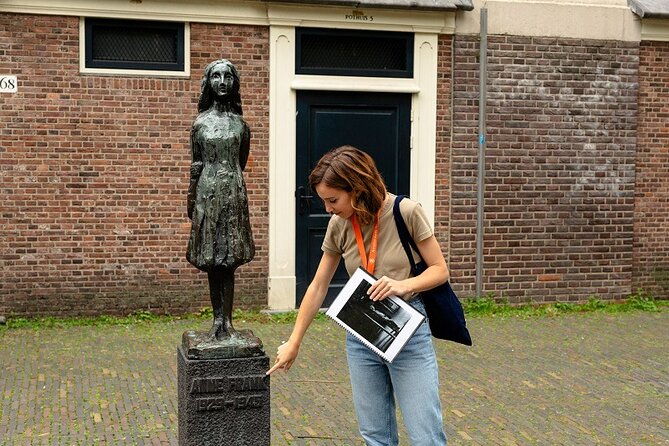
The first hour starts with a historical walk through Amsterdam’s core areas, focusing on monuments and buildings that still show the scars of war. A good guide can make stone and brick feel like evidence rather than decoration, and this tour is clearly aimed at doing that—explaining how citizens of Amsterdam dealt with occupation pressures.
Then the focus shifts to the Jewish neighborhood, where the route includes major landmarks such as the Portuguese Synagogue and the Jewish Museum area. Even if you’re not going inside every building, having these named points along the way helps you build a mental map. You understand where the community was, where it stood, and what its role became during the conflict.
One reason this part of the experience is so important: it prevents the story from becoming a single tragic snapshot. You get context for what was happening around the people whose lives later became part of the global memory of Anne Frank.
This stop is listed as admission ticket free, which is great for value and for keeping the schedule moving. You can focus on the walk and the guide’s narration without adding extra paid entries during the first hour.
The Portuguese Synagogue and Jewish Museum Area: Why Names Matter
It’s easy to walk past famous buildings and forget them ten minutes later. This tour treats names like clues. When you move through the Jewish neighborhood and your guide points out specific landmarks—like the Portuguese Synagogue and the Jewish Museum—you start to connect geography with history.
For me, that’s one of the best ways to learn in Amsterdam: you’re not just reading about a place, you’re building a route you can revisit later. If you want to understand how neighborhoods shaped wartime experiences, the Jewish Quarter is where you start.
Also, the tour explicitly frames this area as having a significant role during the war. That helps you notice details you might otherwise ignore—who belonged here, what was at stake, and how the community’s story ties into what came next.
Stop 2: Dutch Resistance, the February Strike, and Winter of Hunger
After the neighborhood context, the tour moves into the resistance and survival story. This is where the history becomes more specific and, frankly, more urgent. You’ll hear about Dutch resistance efforts, including the February Strike and the Winter of Hunger.
Those event names aren’t random. They give you a timeline and a sense of pressure. When you understand that resistance and hardship were happening in waves, you can better grasp why hiding, waiting, and trying to survive were so difficult. It also helps you see the difference between being watched and being trapped.
The tour also explains secret locations where families—including the Franks—hid to escape persecution. That part is especially important for keeping the Anne Frank story grounded in the reality of risk. You’re not just learning about a famous diary; you’re learning about the constant fear and decision-making that surrounded survival.
This is the second hour, and the guide’s job here is to make the details feel connected rather than like a list. If you enjoy history told as a chain of cause-and-effect, this segment is the heart of the tour.





Hollandsche Schouwburg: A Deportation Center You Can Still Feel
One of the most meaningful stops is Hollandsche Schouwburg. This former theater was used as a deportation center for Jews during the occupation. Today, it functions as a memorial and museum.
Even without stepping inside, learning what the building was used for changes how you read the space. A theater is designed for public gathering and performance—knowing that the same walls were repurposed for deportations forces a harsh contrast between what a place was meant to be and what it became.
This stop matters because it anchors the story beyond individual survival. It brings the wider system into focus—how occupation policies moved people through locations designed for forced journeys.
If you’re the type who likes your sightseeing to have weight, this is one of those moments where you feel the purpose of the tour.
Finale Near the Anne Frank House: What You’ll Know Before You Go In
The tour concludes near the Anne Frank House, with more on her life and legacy. Think of it as a guided lead-in. You finish with better context, so when you later visit the House itself, the experience is less like walking into a headline and more like walking into a story you already understand.
Important: Anne Frank House admission is not included. Tickets start at €7, and you’ll need to buy them separately from the official Anne Frank House website if you want to go in.
This separation is actually useful. The walking tour gives you the emotional and historical groundwork, and the House visit becomes a second step you can choose when your schedule and ticket situation are ready. Just don’t assume you’re covered—plan to add that cost if you want the full experience.
Price and Value: Is $55.94 Worth It?
At $55.94 per person, this isn’t the cheapest thing you can do in Amsterdam. But it also isn’t trying to be. You’re paying for a professional tour guide, structured storytelling, and a route that connects multiple WWII anchors in a short time.
Here’s why I think the value stacks up well for the right traveler:
- You get two main story legs in one: occupation-era context plus resistance and survival details.
- The first stop is ticket-free as listed, so you’re not double-paying for the same time block.
- The group has a maximum of 45 travelers, which usually helps the guide keep the narrative coherent.
You also want to take note of timing demand. It’s described as being booked on average 34 days in advance, which is a practical hint to lock in your slot early. If you wait until the last minute, you may end up choosing the time that leaves you scrambling for Anne Frank House tickets later.
If you’re a solo traveler, this kind of guided route can be especially efficient. You save the effort of sorting out what to prioritize in the Jewish Quarter and how to connect it to the Anne Frank story.
Who This Tour Fits Best (And Who Might Want Another Plan)
This tour is a strong match if you want:
- a guided walk through the Jewish Quarter with named landmarks,
- WWII context that stays organized,
- and a clear, chronological-feeling build-up toward Anne Frank’s legacy.
It also works well if you don’t have a ton of time. With 2 hours approx., it fits nicely into a day packed with museums and canal wandering. Just remember: this is not “just photos and facts.” It’s a serious topic, and the guide’s narration plays a big role in making it understandable.
If you already plan to spend a long time inside the Anne Frank House, you might wonder if you need this tour too. I’d still consider it, because you’ll start your House visit with a stronger map of the story—resistance, hardship, deportation context, and the survival thread.
Practical Notes That Matter on the Day
A few on-the-ground points can make your experience smoother:
- It’s offered in English, so confirm language if you’re not traveling with English speakers.
- It’s a group tour, and it runs with a maximum of 45 travelers—bring a headset or keep an eye on where the group gathers so you don’t lose the guide when the sidewalk gets busy.
- Confirmation is received at booking time, which helps you plan.
- Service animals are allowed, which is good to know for travelers who need that support.
And yes, bring good walking shoes. Amsterdam sidewalks can be deceptively tricky, especially near historic areas where foot traffic concentrates.
Should You Book This Anne Frank Walking Tour?
If you want a guided way to understand how Amsterdam’s occupation connected to the Jewish Quarter, resistance, hiding, and deportation, then yes—this tour is an efficient, emotionally serious way to do it. The biggest reason to book is that it gives you a coherent story arc in 2 hours, ending near the Anne Frank House with enough context to make your follow-up visit (if you choose it) feel more meaningful.
Just go in with your eyes open: Anne Frank House tickets are separate, and that can affect your timing. If you’re serious about visiting the House, plan your day so you can buy tickets and not feel rushed.
FAQ
How long is the Anne Frank Walking Tour?
The tour lasts about 2 hours.
Is the tour offered in English?
Yes. This experience is offered in English.
Where does the tour start?
The meeting point is Nieuwe Amstelstraat 1, 1011 RH Amsterdam, Netherlands.
Is admission to the Anne Frank House included?
No. Entrance to the Anne Frank House is not included. Tickets start at €7 and must be purchased separately from the official Anne Frank House website.
What’s the maximum group size?
The tour has a maximum of 45 travelers.
Are service animals allowed?
Yes. Service animals are allowed.
Can I get a refund if I cancel?
No. The experience is non-refundable and cannot be changed for any reason.