REVIEW · AMSTERDAM
Bike tour in Amsterdam with an Italian guide
Book on Viator →Operated by AmsterdamViaggi · Bookable on Viator
One bike ride can explain a whole city. This Amsterdam tour pairs an Italian guide with 11 km of cycle paths so you can photograph major sights and understand what you’re seeing, from Dam Square to the historic red-light streets. I especially like the Italian storytelling (clear, not boring) and the fact that you’re given a bicycle and guided route so you don’t waste time figuring things out. The main catch is that you’ll cover a fair distance, and museum entry fees are not included.
You start at the Anantara Grand Hotel Krasnapolsky Amsterdam (Dam 9) and come back there. It’s built for 3 hours 30 minutes of city time, with a pace that’s meant for moderate fitness, plus clear handling through busy areas.
In This Review
- Key highlights you’ll feel fast
- Getting rolling: Dam 9 meeting point and a bike-ready start
- Dam Square, Royal Palace area, and the canal-ring intro
- Jordaan and the Anne Frank area: small streets, big stories
- Museumplein, Vondelpark edge, and art landmarks from the bike
- Flower Market and Rembrandtplein: color, commerce, and junctions
- Down the Amstel and over the Skinny Bridge: viewpoints with motion
- Jewish Quarter, Nieuwmarkt, and the public weighbridge
- De Hallen red-light streets: history and respectful observation
- Price and value: what $72 buys in real city time
- Who should book this bike tour (and who should skip it)
- Should you book this Amsterdam bike tour?
- FAQ
- FAQ
- What’s included in the ticket?
- How long is the bike tour?
- How much cycling will I do?
- Do I need museum tickets?
- Where does the tour start and end?
- What time does the tour run?
- What if the weather is bad or not enough people sign up?
Key highlights you’ll feel fast
- 11 km of cycle paths designed for photos and frequent stopping points
- Italian guide at native level, with explanations that stay on track
- A classic route through core Amsterdam, plus the Jordaan, Jewish Quarter, and Nieuwmarkt
- Major landmarks viewed from the bike, including Dam Square, Flower Market, Rembrandt areas, and Nemo
- Bicycle included, so you avoid the time and hassle of rentals
- Red-light area included, but framed as history and context rather than just spectacle
Getting rolling: Dam 9 meeting point and a bike-ready start
The tour meets at Anantara Grand Hotel Krasnapolsky Amsterdam on Dam 9. It’s a sensible pick: easy to find, and you’re near public transportation, which matters if your day is already packed. The route is designed around the idea that you won’t just “see” Amsterdam—you’ll move through it in a way that makes sense.
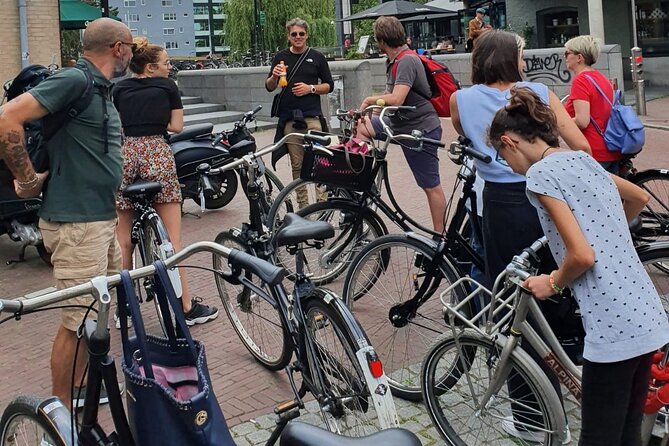
A big value point here is that the bicycle is included. That means you can show up, get your bike, and start learning immediately. You also aren’t forced into a long pre-tour bike hunt or a separate rental process, which can quietly eat an afternoon in a city like this.
The guide is Italian and speaks at native level. In practice, that makes a difference when you want context. Amsterdam isn’t just canals and bicycles; it’s trade, neighborhoods, and changing social life over centuries. With a guide like Fabio (and, at times, Luca as part of the supporting team), the explanations tend to stay focused and easy to follow, not a random list of facts.
One note on timing: the stated window is roughly 3.5 hours, but a past group reported it ran close to five. That’s not necessarily a bad thing. It usually means more questions, more stops, and a slower pace that helps the story land. Just keep that in mind if you have dinner reservations right after.
You can also read our reviews of more cycling tours in Amsterdam


Dam Square, Royal Palace area, and the canal-ring intro
The tour kicks off with the big-city markers: Dam Square and the Royal Palace area. This is where you get your mental map. You start with a wide, recognizable public space, then quickly shift into the canal geometry that shapes how the whole city feels.
Dam Square is also where you learn how Amsterdam holds history in plain sight. The architecture and layout aren’t frozen in a museum. It’s a working civic center. From there, the route works its way along Singel, one of the city’s historic canal bands, which helps you connect what you see on the street with the way the canals structured movement and trade.
If you like photos, this early phase matters. The tour is framed around cycle paths and frequent photo moments. You’re not stuck waiting for a single long “walk break.” You can capture the big look quickly, then keep moving while the guide gives context.
Potential drawback here: because it’s a central area, expect crowds. The upside is that the bike format lets you move through with less “bottleneck frustration” than you’d get on foot.
Jordaan and the Anne Frank area: small streets, big stories
From the core civic spaces, you head toward the Jordaan and the area around Anne Frank’s house. This is one of Amsterdam’s most human-scale zones. The streets feel narrower, the facades closer, and the neighborhood vibe changes fast from the grand public squares.
What I like about this section is the way it turns a famous name into a lived-in place. Instead of treating Anne Frank as a poster, the guide ties the area to the city’s residential history and the way neighborhoods grew and changed around trade and migration. That’s the difference between knowing a fact and understanding why it happened here.
You also get practical rhythm: cycle, short stop, explanation, cycle again. The tour is set up so you’re not constantly dismounted for long periods, which helps if you’re trying to cover a lot without draining yourself.
One consideration: if you’re hoping for a long, quiet pause specifically to wait in line or linger at any one site, this isn’t that kind of tour. It’s a guided circuit focused on seeing many key sights, not museum-depth timing. If you want museum time, plan it separately.
Museumplein, Vondelpark edge, and art landmarks from the bike
After the Jordaan section, the route heads through areas that connect Amsterdam’s major cultural blocks. Depending on the exact day’s flow, you’ll pass landmarks tied to the Museumplein area, and you might see parts of the Vondelpark zone and art-focused stretches.
This is where a bike tour shines. Museums can feel like islands if you only enter one or two. On the bike, you get the context of why this area matters: it’s not just art buildings. It’s a cultural district that influences how the city works and how visitors move.
The guide also ties the modern landmarks back to older patterns—how the city’s prosperity shaped streets, institutions, and the way people gather in public. If you’re the type who likes to understand what connects the dots, this section is worth it.
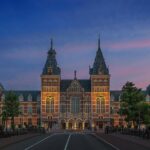
And yes, you’ll notice major names like Van Gogh and the Rijksmuseum area as you glide past. Even without entering, seeing where they sit in the city helps you plan a follow-up day if any particular museum grabs you.
Flower Market and Rembrandtplein: color, commerce, and junctions
Next comes a classic Amsterdam contrast: the Flower Market area and then Rembrandtplein. This is a shift from residential streets and civic space into a place that feels built for movement—shopping, meeting, and simply watching life happen.
I like that the tour doesn’t treat these stops like checkboxes. The guide frames them as part of Amsterdam’s economic history and day-to-day rhythms. Flower markets are more than pretty. They reflect the city’s long relationship with trade, seasonal cycles, and public commerce.
Rembrandtplein then becomes a key reference point. It’s one of the city’s major squares, and your ride around it helps you understand the layout of central Amsterdam. From a photography standpoint, this is also a good area to capture open-square energy before you head back into canal-and-bridge terrain.
If you’re sensitive to crowds, plan to keep your expectations realistic. This is a central hub, and you’ll be near other bikes and pedestrians. The benefit is that the bike guide helps you stay oriented without getting swallowed by slow walking lines.
You can also read our reviews of more guided tours in Amsterdam



Down the Amstel and over the Skinny Bridge: viewpoints with motion
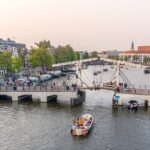
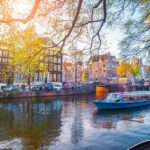
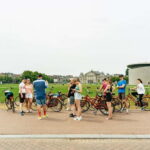
Then the route turns toward the Amstel and iconic bridge moments, including the Skinny Bridge area. Crossing bridges in Amsterdam isn’t just about getting from A to B. It’s about perspective. Each bridge frames the waterway like a moving photo border.
The Skinny Bridge is narrow and famous for a reason. Even if you’ve seen pictures before, experiencing it as part of a bike circuit changes how you understand it. You see how it fits into the surrounding street grid and how people actually flow around it.
This segment is where the “11 km of cycle path” idea pays off. You aren’t stuck in one location for too long. You get series of views. That matters if you’re trying to understand the city as a system, not a list of highlights.
Jewish Quarter, Nieuwmarkt, and the public weighbridge
After the Amstel, you move into the Jewish Quarter and toward Nieuwmarkt, including the area of the public weighbridge. This is one of the tour’s strongest parts for anyone who likes real context.
The Jewish Quarter section helps you move beyond the postcard versions of Amsterdam. You see how neighborhoods are shaped by history and by practical city needs—housing, trade, and social life. Then you hit Nieuwmarkt, where the vibe shifts again into a market-square feeling.
The public weighbridge adds an interesting layer. It’s a reminder that Amsterdam wasn’t just artistic and scenic. It was commercial and logistical. Places like this reflect how trade worked—how goods moved, how value was assessed, and how the city functioned day to day.
Even if you don’t know the details, the guide’s job is to connect you to them. That connection is what makes the cycling worth it.
De Hallen red-light streets: history and respectful observation
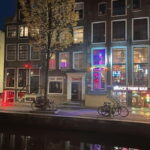
Finally, the route includes the historic red-light areas, including the three streets of De Hallen. Amsterdam is honest about its contrasts, and this tour doesn’t try to hide that. The way it’s handled matters: you’re not just pointed at it. You get a frame for understanding the area as part of the city’s changing social history.
The benefit of seeing this on a guided cycle is pacing and context. On foot, it’s easy to turn a history section into a chaotic detour. On bike, you keep your orientation. The guide can explain what you’re looking at and why it’s in this neighborhood, and you’re not left to guess.
Respect matters here. This is a place where people live their lives. If you keep a normal, non-intrusive posture, the experience stays informative instead of awkward.
Price and value: what $72 buys in real city time
At $72 for roughly 3 hours 30 minutes, this tour lands in the “good value” category if your goal is city understanding over shopping or museum time. Why? Because you get:
- a bicycle included
- an Italian mother-tongue guide
- a route that covers major sights and several neighborhoods
- enough movement to see a lot without burning hours
The big thing not included is museum entry. That’s normal for a bike circuit, and it actually helps you control your day. If you want to spend more time inside any museum, you can add it later with a ticket on your own schedule.
What about the distance? “Just over 11 km of cycle path” sounds simple, but it’s still real biking time. You should be comfortable with moderate cycling for a few hours. The tour is aimed at people with moderate physical fitness, so if you’re new to bikes or you hate any sustained pedaling, you might find it more work than you expect.
Also, the tour has a minimum group size of 4 to depart and a maximum of 25. That usually helps with guide control: you get enough group energy to make it lively, but not so many people that the ride feels chaotic.
Who should book this bike tour (and who should skip it)
This tour is ideal for you if:
- you have limited time in Amsterdam and want strong coverage of key areas
- you like getting a guide’s story while moving through neighborhoods
- you’re comfortable riding a bike for about 11 km and staying alert in busy zones
- you want photo opportunities built into the route
It may not be ideal if:
- you want deep museum time as part of the experience (entrances are not included)
- you’re looking for a fully relaxed walking tour pace
- you’re very sensitive to crowds, since you’ll pass through central squares and popular sights
- your schedule is tight with no buffer, because the ride length can run longer depending on how the group moves
If you’re traveling with family, keep the fitness and riding comfort in mind. The tour is described for moderate fitness, and it’s capped at a group size that still requires the guide to keep momentum.
Should you book this Amsterdam bike tour?
Yes, I’d book it if your priority is to understand the city quickly and see several neighborhood “chapters” in one afternoon. The combination of Italian guiding plus a route built around major sights makes it a smart use of time. You’ll finish with a clearer sense of where things connect: squares, canals, markets, and the neighborhoods where Amsterdam’s layers show up.
Skip it only if you’re chasing museum entry time, or if biking distance is a dealbreaker. In that case, a walking focus or a shorter bike route might fit better.
FAQ
FAQ
What’s included in the ticket?
The tour includes Italian assistance, an expert Italian mother-tongue guide, and use of bicycle. Museum entrances are not included.
How long is the bike tour?
The duration is about 3 hours 30 minutes (approx.).
How much cycling will I do?
The route is just over 11 km on cycle paths.
Do I need museum tickets?
No. Entrance to museums is not included, so if you want to go inside, you’ll need separate tickets.
Where does the tour start and end?
It starts at Anantara Grand Hotel Krasnapolsky Amsterdam, Dam 9, 1012 GJ Amsterdam and ends back at the same meeting point.
What time does the tour run?
It runs Monday to Sunday from 2:00 PM to 5:30 PM.
What if the weather is bad or not enough people sign up?
The experience requires good weather. If canceled due to poor weather, you’ll be offered a different date or a full refund. It also has a minimum number of travelers, and if it doesn’t meet that minimum, you’ll be offered a different date/experience or a full refund.