REVIEW · AMSTERDAM
Amsterdam in World War II Tour
Book on Viator →Operated by Slagveldreizen.nl · Bookable on Viator
Amsterdam’s WWII story is written into the streets. This small-group walking tour connects Jewish history and the German occupation with specific, real locations in central Amsterdam. You also get a rare kind of guiding: three retired historians telling the story with photos and context, not just dates.
What I like most is the small group size of up to 8. That keeps the pace calm (slow walking) and makes it easier to ask questions without shouting over a crowd. A second standout is the route itself: you move from major memory sites like Anne Frank House and Dam Square to lesser-discussed places tied to occupation-era systems, including the old post office building at Magna Plaza.
One thing to consider is the tone: this is not a casual city stroll. It’s a moving tour about persecution and violence, and some sections are heavy. If you want only light sightseeing, you may find it emotionally intense.
In This Review
- Key highlights worth planning around
- A WWII walking tour that explains what you’re seeing
- Small-group logistics: meeting on Prinsengracht and finishing at the names monument
- How the guides use streets, photos, and a careful pace
- Stop-by-stop: occupation sites to Anne Frank House exterior in under an hour
- Multatuli statue, Singel bridge, and how Amsterdam changed after 1945
- Magna Plaza: a former post office tied to executions
- Nieuwe Kerk and the story on the streets toward Dam Square
- Dam Square: occupation events, May 7, 1945, and the monument story
- Sofitel Legend The Grand Amsterdam: city hall during occupation
- Price and value: $46.44 for a focused 3–3.5 hour education
- What you’ll feel after: heavy facts, but a clear structure
- Who should book this Amsterdam World War II tour
- Should you book it? My practical verdict
- FAQ
- How long is the Amsterdam in World War II tour?
- How big is the group?
- What’s the meeting point and start time?
- Where does the tour end?
- What’s included in the price?
- Is coffee or tea included?
- Do you go inside Anne Frank House?
- Is admission required for the stops?
- What if the weather is bad?
- Can I cancel for a full refund?
Key highlights worth planning around
- Up to 8 people means you get attention and you don’t get dragged along.
- Retired historians as guides bring documents, photographs, and a teacher-style flow.
- No museum stop for Anne Frank House: you start outside and focus on the story.
- Dam Square details you’ll miss on your own, including a May 7, 1945 shooting incident.
- Magna Plaza as a WWII post office site, tied to Dutch postmen executed by Germans.
- Route ends at the National Holocaust Names Monument, near the Portuguese Synagogue and close to city hall.
A WWII walking tour that explains what you’re seeing
Amsterdam in World War II is one of those topics where the city’s normal charm can trick you. This tour helps you read the streets correctly, because it pairs each stop with the specific occupation-era meaning behind it.
I like that the guides are not actors reciting a script. The tour is led by three retired historians with a serious passion for how the German occupation worked in the Netherlands from 1940 to 1945. They also use period photos and visual aids so the city feels less like a textbook and more like a place where events actually happened.
You’ll also get a steady structure. The walking pace is slow, the total time runs about 3 to 3.5 hours, and the stops are arranged so context builds rather than jumping around.
You can also read our reviews of more tours and experiences in Amsterdam.
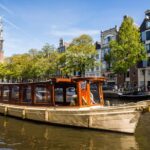
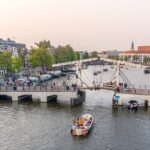

Small-group logistics: meeting on Prinsengracht and finishing at the names monument
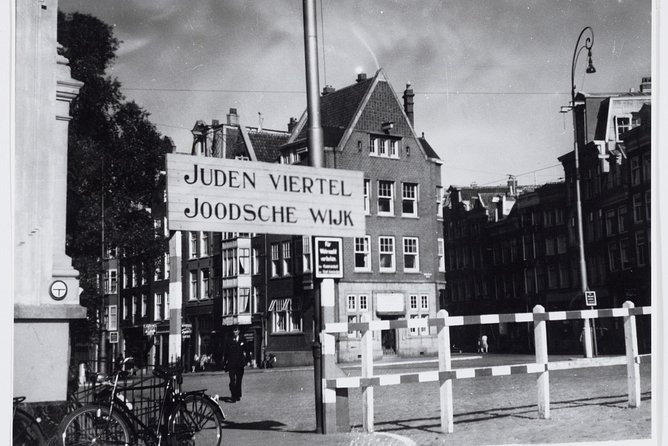
The tour starts at Prinsengracht 263, 1016 GV Amsterdam, at 9:30 am. The meeting spot is easy to recognize if you check the map ahead of time, and it’s in a central area that’s also convenient if you’re using public transportation.
You finish at the National Holocaust Names Monument (1018 DP). The site is close to the Portuguese Synagogue, and not far from city hall, which is handy if you want to keep exploring after the tour ends.
The group limit matters here. With a maximum of 8 travelers, the guide can adjust if someone needs a slower moment or has a specific question. That’s especially useful on a topic like this, where people often want to understand the details.
How the guides use streets, photos, and a careful pace
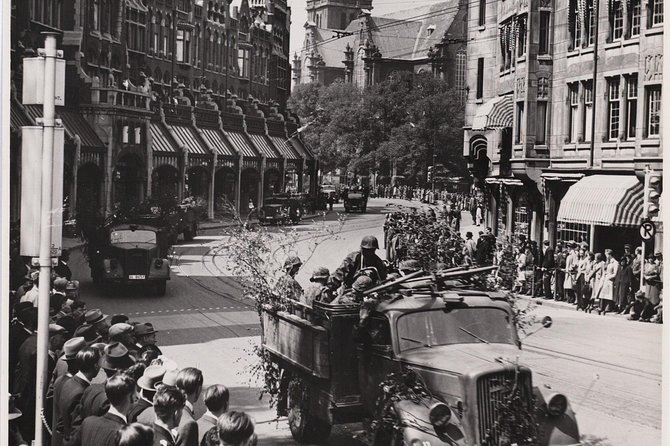
A lot of history walks tell you where to stand. This one tries to help you understand why that exact corner matters.
The guides are historians first, so you’ll hear explanations that connect places to systems: occupation, persecution, resistance, and the way memorials shape how we remember. Reviews also point to guides arriving with photos, maps, and notes—stuff that makes the story feel anchored in evidence, not just storytelling.
Because the pace is intentionally slow, you’ll have time to absorb and re-orient. That matters when you’re moving between canal neighborhoods, courtyards, and big squares where the city’s current look can clash with what happened there.
Stop-by-stop: occupation sites to Anne Frank House exterior in under an hour
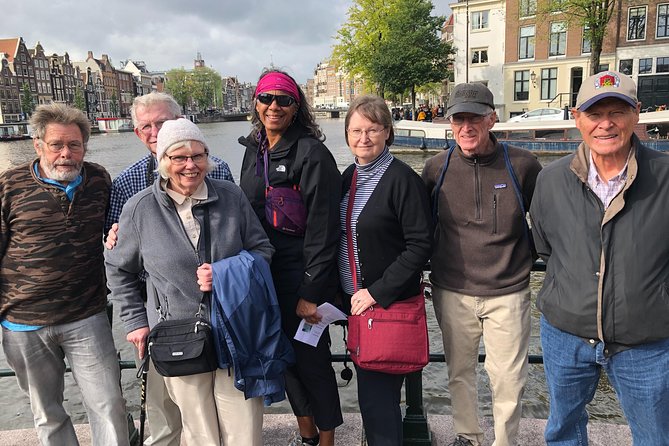
The itinerary starts with a longer orientation segment: about 2 hours 30 minutes spent at key WWII sites and monuments tied to the Nazi occupation of Amsterdam (1940–45). This part is the backbone of the tour, because it sets the framework for what you’ll notice later.
You’ll then reach Anne Frank House—but with an important clarification. You’ll begin outside, and the guide tells the story of the German attack and the Jewish refugees. The tour does not visit the Anne Frank House museum, and the ticket for the museum is listed as not included.
In practice, that means you can experience the significance of the location without spending time in the museum queue or timeline. It’s a good fit if you want the tour to focus on the occupation context around the Jewish Quarter rather than turning the walk into a museum day.
Multatuli statue, Singel bridge, and how Amsterdam changed after 1945
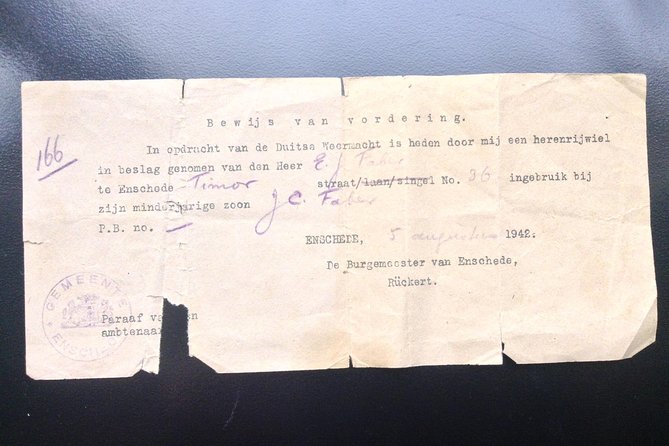
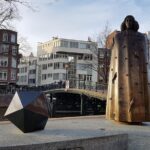
A quick stop follows at the Statue of Multatuli in the Raadhuisstraat, plus a look at the bridge over the Singel. It’s short—around 10 minutes—but it’s not filler.
This kind of stop is how the tour shows transformation. You’re reminded that the city didn’t freeze in 1945. It rebuilt, shifted, and re-used its urban spaces, often layering postwar life over wartime memory.
Even if you’re mainly focused on WWII facts, I find these short “then and now” interruptions helpful. They prevent the walk from feeling like a single long dark corridor with no room to breathe.


Magna Plaza: a former post office tied to executions
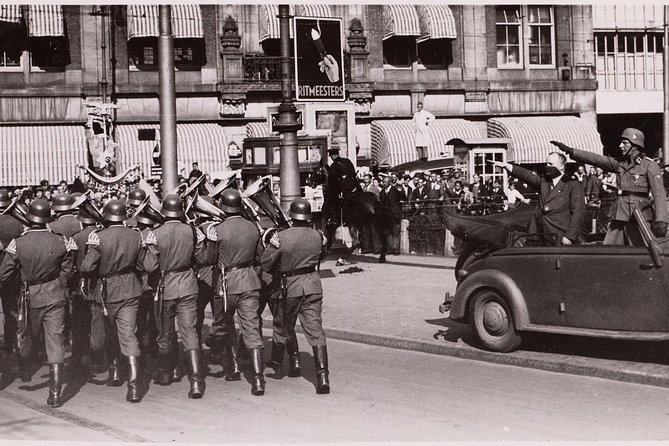
Next is Magna Plaza, about 5 minutes. Today it’s a mall, but during WWII it served as the post office of Amsterdam.
The guide connects the building to a brutal reality: Dutch postmen were executed by the Germans. That’s a specific, concrete detail that helps you understand how occupation control reached into everyday systems like mail and communications.
Because this stop is brief, you get the key story and move on. If you like taking photos, you’ll want to be ready quickly here, since the time window is small.
Nieuwe Kerk and the story on the streets toward Dam Square
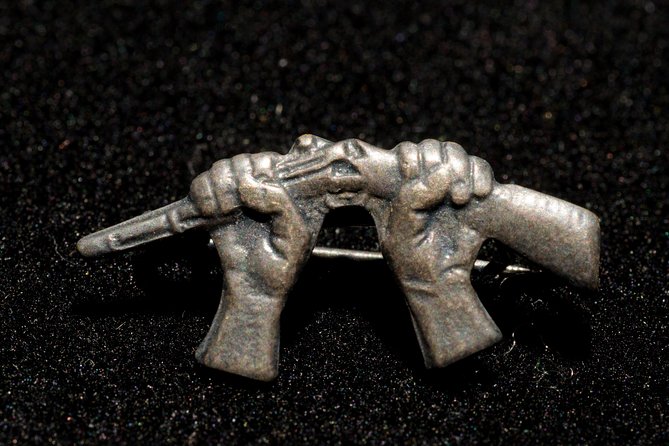
You’ll then pass by the Nieuwe Kerk area for about 5 minutes. There’s a WWII story connected to the street between the Royal Palace and the New Church, specifically the Mozes en Aäronstraat.
This is where the tour’s walking style pays off. The street network in central Amsterdam can feel like a maze. Having a guide connect a named street to occupation-era meaning is one of the best ways to avoid getting lost while still seeing the right places.
It also helps you notice how history plays out in narrow streets and small sight lines. You’re not just seeing famous monuments; you’re learning how to read the city’s layout as part of the story.
Dam Square: occupation events, May 7, 1945, and the monument story
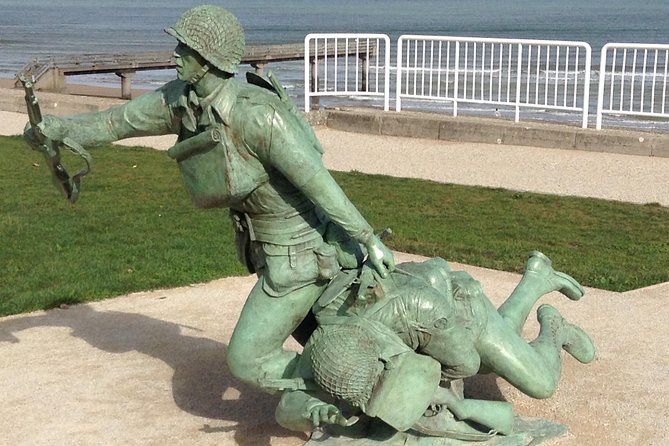
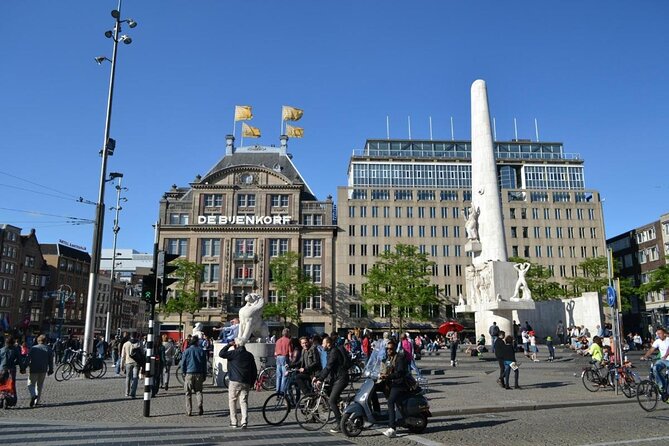
Dam Square is the emotional center of many Amsterdam histories, and this tour gives it time—around 25 minutes.
The guide points out how a lot happened there during the occupation. One detail that stands out is the shooting incident on May 7, 1945, two days after the German surrender. The tour also explains that Dutch volunteers were recruited there for the so-called crusade against Bolshevism.
You’ll also hear about Remembrance Day on May 4 and a story connected to the WWII monument in the square. This is the kind of stop where you might want to slow your own thoughts down and just listen. The square is large and busy in normal life, so hearing the occupation timeline from a guide helps you make sense of how the city marks grief and memory.
Sofitel Legend The Grand Amsterdam: city hall during occupation
The final stop is Sofitel Legend The Grand Amsterdam (also tied to the Grand Hotel/The Grand). It’s about 5 minutes, but it lands with a clear WWII detail.
During the occupation, the building was the City Hall. The guide notes that German troops were welcomed by Dutch civil servants on May 15, 1940.
This ending is a strong way to close the arc. It connects occupation authority to Dutch institutions, showing how power and collaboration can be part of the historical record. Even when a stop is short, the point is clear: WWII in Amsterdam wasn’t just something happening in the background—it interacted with official civic life.
Price and value: $46.44 for a focused 3–3.5 hour education
At $46.44 per person, this isn’t cheap in the way of a free canal walk, but it’s also not in the museum-private-guide category. For the value, you’re paying for three things you rarely get together:
First, the tour is small-group capped at 8. That alone makes the per-person cost feel more reasonable than big-bus history tours.
Second, you’re getting a guided walk built around multiple specific locations linked to WWII, including places like Magna Plaza where the WWII connection isn’t obvious from the outside. The itinerary is designed so the history isn’t random; each stop has a reason.
Third, you’re paying for historical method. The guides use photos and maps and answer questions with real substance. Reviews repeatedly mention visuals like photos, log-style notes, and copies of materials you can take home. That turns the tour into something you can remember and research later.
One practical note: coffee and/or tea isn’t included. If you want warmth or a snack plan, build it into your day. You can also keep your expectations aligned: the tour is about history and walking, not a café experience.
What you’ll feel after: heavy facts, but a clear structure
This tour is moving because it covers Jewish heritage and the Holocaust in the context of the Nazi occupation. It includes places tied to persecution and violence, and it doesn’t pretend that the story is simple.
Still, the pacing and stop selection matter. The guide uses a route that gives you context first, then anchors it with key sites like Anne Frank House and Dam Square, and then brings you to remembrance at the National Holocaust Names Monument. That ending point helps you transition from facts to meaning.
I also appreciate the restraint of not turning everything into a museum stop. Starting outside Anne Frank House keeps the tour focused on occupation context instead of shifting into ticketed museum time.
Who should book this Amsterdam World War II tour
Book this if you fit one of these profiles:
- You want WWII in Amsterdam with a clear explanation, not a scattered self-guided route.
- You like small groups and a calm walking pace.
- You’re interested in the Jewish Quarter context and how Amsterdam’s daily systems were affected.
- You prefer a guide who uses photos, maps, and written materials to make history concrete.
You might skip it if you want only light sightseeing, or if you get overwhelmed by topics involving persecution. Also, since the tour depends on good weather, plan an alternate slot on days with wind or rain.
Should you book it? My practical verdict
If your goal is to understand how Amsterdam functioned during the German occupation, this tour is a strong pick. The up-to-8 format, historian-led guiding, and the sequence of stops—from Anne Frank House exterior to Dam Square and ending at the Names Monument—make it feel like an organized walk through a complicated time.
I’d book it if you want authentic place-based learning and you’re okay with a serious tone. It’s also a smart use of time: in about 3 to 3.5 hours, you cover major landmarks and a few key “you’d miss this on your own” WWII connections.
FAQ
How long is the Amsterdam in World War II tour?
It runs about 3 hours to 3 hours 30 minutes, with a slow walking pace.
How big is the group?
The tour is limited to a maximum of 8 travelers.
What’s the meeting point and start time?
The meeting point is Prinsengracht 263, 1016 GV Amsterdam, and the start time is 9:30 am.
Where does the tour end?
It ends at the National Holocaust Names Monument (1018 DP Amsterdam), close to the Portuguese Synagogue and not far from city hall.
What’s included in the price?
The guided tour is included.
Is coffee or tea included?
No, coffee and/or tea is not included.
Do you go inside Anne Frank House?
No. You start outside and the guide tells the story, but the museum is not visited. Admission for the museum is not included.
Is admission required for the stops?
Most stops list admission tickets as free. The tour itself includes the guide, but Anne Frank House museum admission is listed as not included.
What if the weather is bad?
This tour requires good weather. If it’s canceled due to poor weather, you’ll be offered a different date or a full refund.
Can I cancel for a full refund?
Yes. You can cancel up to 24 hours in advance for a full refund.