REVIEW · AMSTERDAM
Discover Amsterdam’s city center in this Outside Escape game tour
Book on Viator →Operated by Outside Escape · Bookable on Viator
Amsterdam turns into a puzzle at every stop. This Outside Escape walk takes you through the city center with a phone-guided crime story that nudges you to real sights and real streets.
What I like most is the easy route for getting your bearings fast, even if Amsterdam is new to you. I also like that every listed stop is admission-ticket free, so you’re not paying extra to enjoy iconic landmarks.
One thing to consider: if you play in the evening, it can get dark quickly, so bring a small flashlight so the clues don’t get harder than the story.
In This Review
- Key points before you go
- How the Outside Escape game-walk works (and why it feels practical)
- Start at Rembrandt House Museum, then ease into the Zuiderkerk (Stop 1)
- Canals and bridges via Staalstraat (Stop 2): the fastest way to feel Amsterdam
- Munttoren and lively squares (Stop 3): Tower of Coins energy
- Bloemenmarkt’s color burst (Stop 4): flowers by the canal
- Spui (Stop 5): an old water lock turned into a square
- Nieuwezijds Voorburgwal 258 (Stop 6) and the canal-house clues
- Dam Square finale (Stop 7): Amsterdam’s historical heart
- Time, pacing, and who this tour fits best
- Price and value: $6.01 for a city-center game
- Practical tips: language, light, and avoiding frustration
- Should you book this Amsterdam city escape walk?
- FAQ
- How long is the Amsterdam city center escape game walk?
- Where does the tour start and where does it end?
- Is it self-guided or do I meet a guide?
- Do the stops require paid admission tickets?
- Is the experience available in English?
- What is the cancellation policy?
Key points before you go
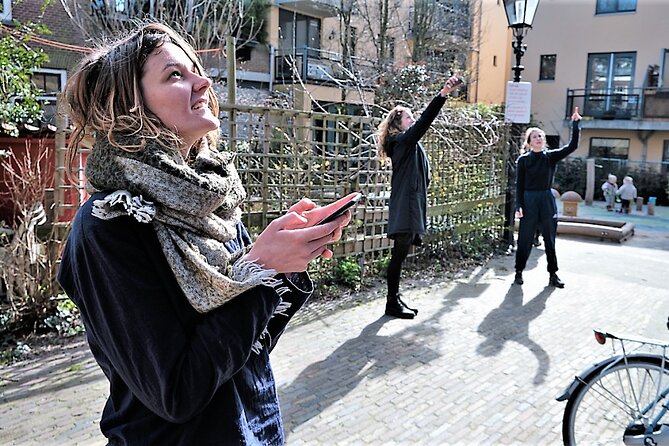
- Self-guided at your own pace with a city-center walking route
- Admission-free stops along the way, so your money stays focused on the game
- Progressive puzzles that tend to land in the easy-to-medium range, with help built in
- City orientation built in: canals, bridges, churches, and squares in a tight loop
- A final score that adds friendly pressure (even when you’re taking it slow)
- Works well for groups who like to split up tasks and compare clues
How the Outside Escape game-walk works (and why it feels practical)
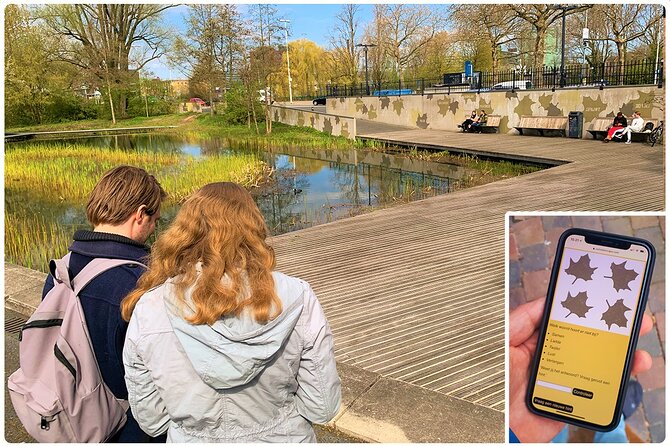
Think of this as an escape game with good shoes. You’re not stuck in one room or waiting for a guide. Instead, you walk a clear path through Amsterdam’s center while the story asks you questions, checks images, and gives you small challenges tied to where you are.
The format is designed for real city pacing. You should expect to stop, read, look up at details on buildings and streets, and then move on. Because it’s not built like a timed sprint, you can pause for a coffee or a quick snack without ruining the whole experience. That matters in Amsterdam, where the best moments often happen when you slow down a bit.
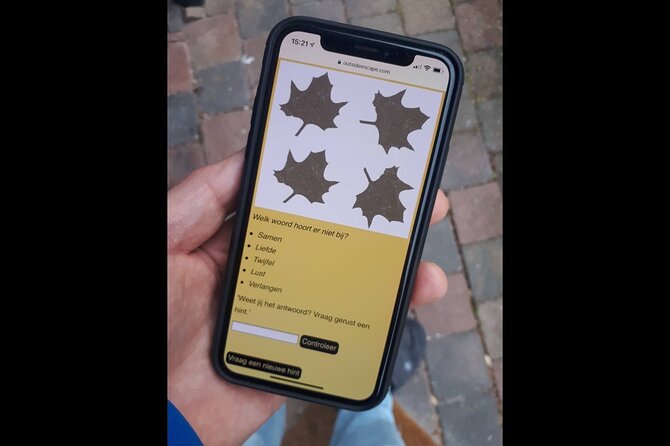
The puzzles also reward attention, not speed. One review-style detail I really like in the design is that you may need to search for items in photos even when the photo doesn’t hand you an obvious location tag. That keeps you looking around—at canal edges, bridge approaches, and building fronts—rather than just walking from one landmark to the next.
Difficulty-wise, the game tends to land in the easy-to-medium zone, with clues available if you get stuck. That makes it friendly for mixed groups: people who love puzzles can push farther, and people who just want a fun walk can still participate.
You can also read our reviews of more city tours in Amsterdam



Start at Rembrandt House Museum, then ease into the Zuiderkerk (Stop 1)
Your walk begins at Rembrandt House Museum (Jodenbreestraat 4, 1011 NK Amsterdam). This is a solid start point because it’s central, easy to reach, and it puts you in the older, walkable fabric of the city right away. The experience also runs during a wide daily window (7:00 AM to 10:00 PM), so you can match it to your Amsterdam rhythm.
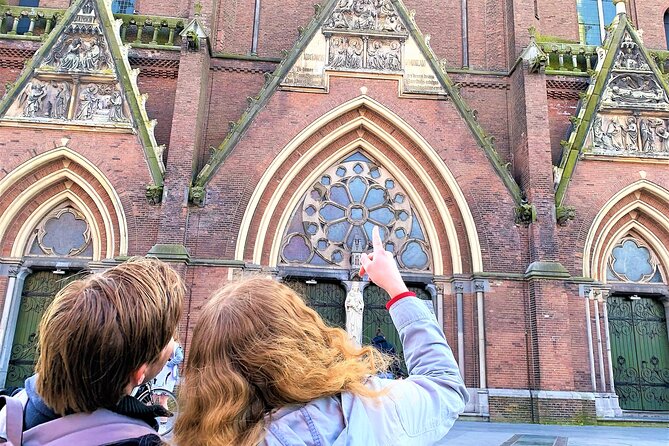
The first stop is Zuiderkerkhof 33, where you’ll find the Zuiderkerk. This church was built between 1603 and 1611 in a Dutch Renaissance style, and it’s a great “first sight” because it gives you something real and architectural to anchor the story.
You’ll only spend about 5 minutes here. That quick timing is practical. It helps you settle into the game without turning Stop 1 into a mini-lecture. If you’re the type who likes to look up details—stonework, rooflines, and the way the church sits in its square—you’ll get enough to feel the place.
And yes: there’s no paid admission attached to this stop. That makes the start feel low-pressure. You can focus on solving the first pieces of the story instead of budgeting for ticket time.
Canals and bridges via Staalstraat (Stop 2): the fastest way to feel Amsterdam

Stop 2 is Staalstraat 7B, and this is where the route starts teaching you the city. The game takes you to typical Amsterdam neighborhoods where you’ll cross some of the iconic canals and bridges, turning what could be “just walking” into real orientation.
You’ll spend about 10 minutes here, and that’s enough time to do two things:
- slow down long enough to notice canal form and bridge angles
- use the surroundings to solve the next part of the story
If you’ve never navigated central Amsterdam before, this stage helps a lot. You start to recognize the patterns: canal frontage, bridge crossings that change your sightlines, and streets that feel like they run in parallel but actually connect through bridges and side turns.
This is also a good part to keep your eyes up. The clues work best when you’re reading small details, not just trying to reach the next numbered spot like it’s a scavenger hunt race.
Munttoren and lively squares (Stop 3): Tower of Coins energy
Stop 3 is Munttoren, known as the Tower of Coins. It sits near one of the more lively squares in Amsterdam, so expect a mix of people, bikes, and that “you’re in the center of it all” feeling.
Time here is about 5 minutes, but the payoff can be big. Munttoren is one of those landmarks you can recognize again and again once you know where it is. Even if you don’t go inside anything (and this stop is listed as admission-ticket free), you’ll get a clear sense of the skyline and the square layout.
Practical tip: take your time just enough to find the view direction you want. Since the game ties clues to what you see at each stop, being slightly deliberate here can prevent a frustrating loop later.
Bloemenmarkt’s color burst (Stop 4): flowers by the canal
Next up: Bloemenmarkt, the famous canal-side flower market. This is one of the most instantly Instagrammable stretches in the city, but the game also uses it like a calm reset button. You’re moving through a busy area and then getting a visual feast that’s easy to connect with clues.
You’ll spend about 10 minutes at this stop, and you can treat it like a break without losing the plot. Since admission is listed as free, you’re not paying to access the scene. You’re paying for the walk-game experience, and this stop helps justify that choice by making the walk itself feel rewarding.
If you’re with kids, this is the kind of place that keeps attention. They can still solve the story pieces, but they’re also seeing something fun and sensory right in front of them.
One consideration: expect crowds, especially if you’re playing on a weekend or later in the day. If the area feels packed, don’t fight the flow. Let the game pull you to exactly what you need, then step aside when you’re done solving that piece.





Spui (Stop 5): an old water lock turned into a square
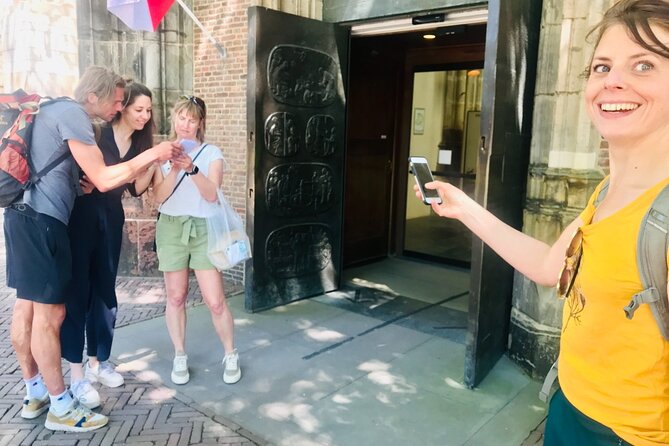
Stop 5 is Spui, about 10 minutes in the game. Here’s the interesting detail: Spui was formerly a water lock, and now it functions as a rustic square with beautiful buildings around it.
That kind of transformation is perfect for an escape game format. The story asks you to look around, and suddenly the square isn’t just a place you pass through. It becomes a location with a specific past, and you start seeing why the layout makes sense.
Because this is part of the route loop, Spui also gives you breathing room. You can stand, reposition yourself for better sightlines, and keep moving when you’re ready—without needing long entry times or waiting for anything to open.
Nieuwezijds Voorburgwal 258 (Stop 6) and the canal-house clues
Stop 6 is Nieuwezijds Voorburgwal 258, and this is a “spot the pattern” stop. The address area used to be a canal, and you can still see that history in the way the stately canal houses line up.
You’ll spend about 10 minutes here. In practice, this stop works best if you do more looking than rushing. The game format tends to reward you for scanning façades, aligning the view with a clue, and spotting small features you might otherwise ignore.
Even if you’ve seen plenty of Amsterdam photos, this is the part that helps you understand how the city’s surface story connects to its water story. It’s a different kind of appreciation: less about one famous landmark and more about how the whole neighborhood was shaped.
Admission is listed as free here as well, which keeps the “game walk” feeling intact. You’re still just moving through the city, solving the case as you go.
Dam Square finale (Stop 7): Amsterdam’s historical heart
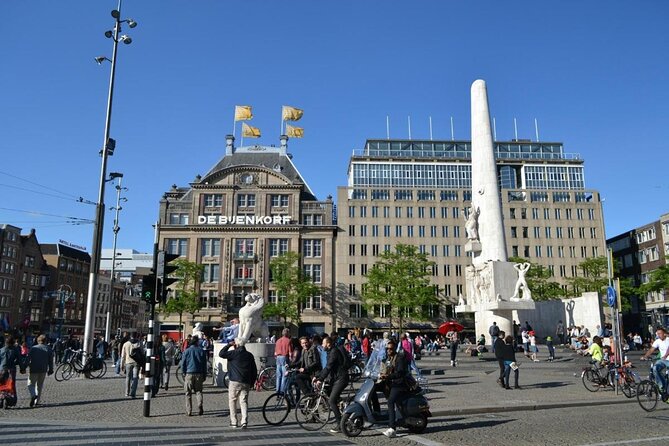
Your last stop is Dam Square, the big open space that’s considered the historical heart of the city. This is where the story wraps up, and time here is about 10 minutes.
Dam Square works as a finale for a simple reason: it’s easy to orient yourself in a big square, and it’s also a place where you naturally slow down. That helps your brain land the ending of the puzzles without needing to sprint toward the finish line.
Expect it to feel like a proper “end scene,” with plenty of people around and a skyline that reads instantly as central Amsterdam. Since this is the final piece, it’s also a smart place to double-check you didn’t miss an earlier clue—especially if the story involved searching for images or specific details.
Time, pacing, and who this tour fits best
This walk is listed as about 1 to 2 hours, and that range is realistic. Your pace matters because the game asks you to stop and think. But the route doesn’t run long. It’s built for city-center walking rather than a full-day commitment.
It’s also flexible for different types of groups:
- Families: the structure is friendly for kids and adults because the story keeps everyone scanning the same places.
- Couples: it’s a fun change from normal sightseeing checklists.
- Colleagues and teams: the experience can work well when you split tasks and trade clues while walking.
One standout detail from the way people describe it is that it’s not a timed pressure cooker. That’s a big deal in a city like Amsterdam where you may want to grab a snack mid-route. You can still complete the story without feeling you’re being punished for taking a breather.
Since this is a private tour/activity that’s for only your group, it also avoids the feeling of being herded by strangers. You control the rhythm.
Price and value: $6.01 for a city-center game
At $6.01 per person, this is priced like a budget-friendly activity that punches above its weight. You’re paying for:
- a structured walking route through major central sights
- a phone-based story with puzzles and hints
- time-efficient experiences that don’t require museum tickets at each stop
That last part is a key value driver. Each listed stop is marked admission ticket free, which means you’re not stacking extra costs onto the game. For Amsterdam, where paid attractions add up fast, that’s genuinely smart.
Also, the route covers a compact stretch: church square, canal-and-bridge crossings, a tower, a flower market, a historical square, canal-house architecture, and Dam Square. You get a lot of variety for a small amount of time and money.
One more value point: this is easy to use without needing transport. You’re walking between sights, so the experience matches the way Amsterdam is best experienced—on foot.
Practical tips: language, light, and avoiding frustration
If you’re aiming for the English experience, you’re in luck: it’s offered in English. Still, I’d keep one practical caution in mind. If you run into Dutch prompts during access, check the materials sent to you after booking, because there’s an English access path included there.
Timing matters too. If you plan to play later in the day, keep in mind that dark comes quickly. Bring a small flashlight so you can still read clues and check details without guessing.
And one last practical move: before you start the walk, make sure your access code works. If it doesn’t, you’ll want to contact the provider so you don’t waste your time on a broken entry.
Should you book this Amsterdam city escape walk?
Book it if you want a fun, puzzle-shaped way to see Amsterdam’s center without committing to a long guided tour or extra museum tickets. It’s especially worth it when you have mixed interests in your group—some people want landmarks, others want an activity, and everyone can participate together.
Pass or reconsider if you dislike puzzles, or if you’re looking for deep museum-level context that takes hours per site. This is a light-footed city walk with story prompts. It’s built for movement and attention, not for long indoor exploring.
If you like walking, enjoy solving clues at a relaxed pace, and want a route that takes you past both famous and slightly less obvious corners, this is an easy win for Amsterdam.
FAQ
How long is the Amsterdam city center escape game walk?
It’s listed at about 1 to 2 hours.
Where does the tour start and where does it end?
You start at Rembrandt House Museum (Jodenbreestraat 4) and end at Dam Square.
Is it self-guided or do I meet a guide?
It’s described as a self-guided route where you walk at your own pace while solving the game.
Do the stops require paid admission tickets?
The listed stops are marked as admission-ticket free.
Is the experience available in English?
Yes, it’s offered in English.
What is the cancellation policy?
You can cancel for a full refund up to 24 hours before the experience start time. If you cancel less than 24 hours before, the amount paid isn’t refunded.